

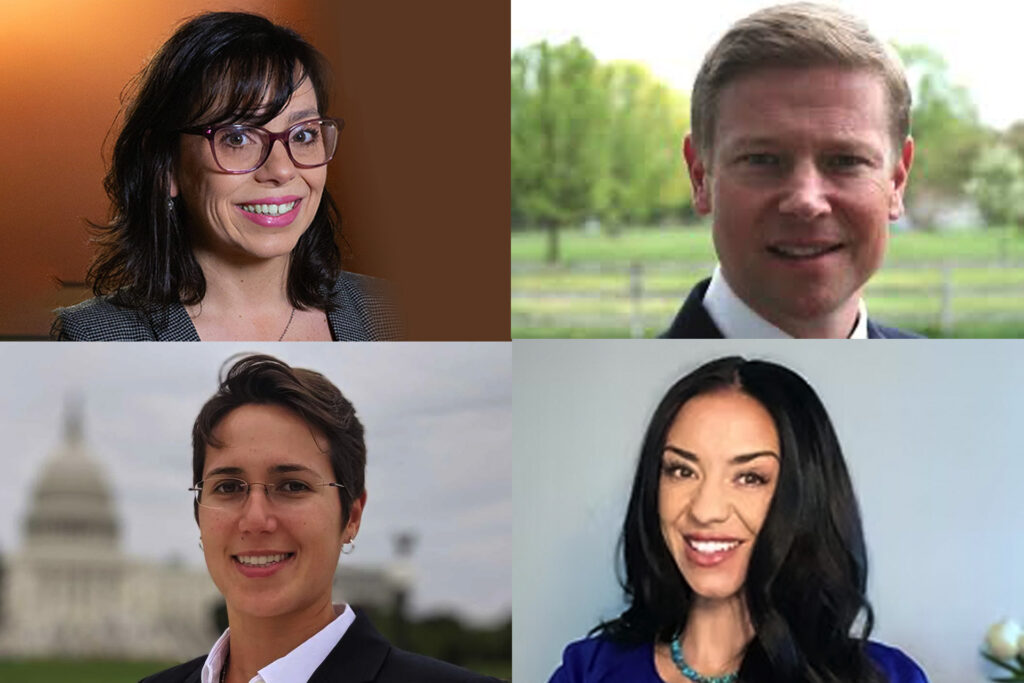
Some states are implementing programs or developing strategies to improve indoor air quality in schools—from legislation and infrastructure investment to inspection programs and voluntary building standards. This panel will explore alternative approaches and practical strategies for achieving healthier school environments at scale. Moderated by Kenneth Mendez, MBA, President and CEO, Asthma and Allergy Foundation of America.
Featured Speakers (Clockwise, top left):
- Representative Megan Cotter, Rhode Island House of Representatives
- Jason Hartke, Ph.D., Executive Vice President of External Affairs and Global Advocacy, International WELL Building Institute
- Rebecca Padilla, MS, Senior Manager, Nationwide Health Promotions, American Lung Association
- Georgia Lagoudas, Ph.D., Senior Fellow, Brown University School of Public Health
Session Focus:
- State experiences and approaches to improving school indoor air quality
- The role of building standards and performance frameworks for school environments
- Challenges states face in implementing large-scale IAQ improvements
- Pathways for policymakers, school systems, and advocates seeking durable solutions
Representative Megan Cotter, Rhode Island. was elected November 8, 2022, to represent District 39 in Exeter, Hopkinton, and Richmond. She is a member of both the House Education Committee, the House Health and Human Services Committee, and the House Small Business Committee.
Representative Cotter has been a strong advocate for forests, farms and conservation. In her first year in the House, she sponsored legislation that created a legislative commission to help the state determine the best action for improving forest management. In 2023 and 2024, she chaired that commission, which issued recommendations that included funding forest fire prevention programs and more forestry staff in the Department of Environmental Management, state and local collaboration to map accessible routes for firefighting in forested lands, and helping owners of forested lands to develop fire management plans. Her leadership and advocacy helped add funding in the 2025 state budget for additional forest rangers at DEM, and led to the addition of land conservation funding to the “green bond” proposal on the ballot in November 2024.
She continues to push for property tax relief, as well as for education, children and rural communities. A law she sponsored in 2025 puts structures in place in all school districts to effectively support students’ mental and behavioral health.
Representative Cotter grew up in the Elmhurst section of Providence, with working parents who divorced when she was young. Her father imparted upon her and her siblings the importance of hard work and kindness, involving the family in church and volunteering for those in need. She graduated from Classical High School in 2002, and went on to University of Rhode Island, where she triple majored in English, Comparative Literature and Classical Studies.
Shortly after college, she married her husband, Christopher. They soon had three children, Emily, Joseph, and Charles. Like many Rhode Islanders, they struggled under the weight of rent, utilities, health care, and student loans, but eventually managed to buy a home in Exeter. When that home was completely destroyed in a fire in 2017, their tragedy was transformed into a profound lesson on kindness and community, as neighbors and friends reached out with support from every direction. Rather than move, they did not hesitate to rebuild in the same spot. They and their children are active volunteers in the community that gave so much to them.
Jason Hartke, Ph.D., is the Executive Vice President of External Affairs and Global Advocacy at the International WELL Building Institute where he leads the organization’s strategic communications, PR and media relations as well as its advocacy efforts and outreach to policymakers around the world. Through dynamic advocacy initiatives and programs, Jason has worked to establish a robust government presence, shaping numerous healthy building policies across all levels of government. He has also launched groundbreaking partnerships and coalitions, including the Healthy Workplaces Coalition, which has grown to nearly 150 member organizations working to support sound health building policy.
Prior to IWBI, Jason was the President of the Alliance to Save Energy (ASE), a nonprofit dedicated to achieving bipartisan policy solutions that advance energy efficiency. While not a registered lobbyist, Jason was recognized as one of The Hill’s Top Lobbyist in 2018 and 2019 for leading ASE’s strategic advocacy efforts to keep energy efficiency a top priority in Washington, helping protect critical R&D programs and significantly increasing federal funding to exceed $1 billion.
Before that Jason led the U.S. Department of Energy’s efforts to advance energy efficiency in commercial buildings, a sector that accounts for nearly 20 percent of the nation’s energy consumption. In the role, Jason managed a nearly $30-million program, working closely with national laboratories as well as industry partners to develop and deploy innovative energy efficiency solutions, strategies and technologies. While there, he helped lead the creation of the Better Communities Alliance and implemented strategic refinements in the technology demonstration pipeline to better catalyze market adoption of innovative energy efficiency solutions.
Jason also spent nearly a decade as a senior executive at the U.S. Green Building Council, leading mission-critical policy and advocacy efforts that helped result in the passage of historic federal investment in green building, new federal leadership programs in energy efficiency, and a fourfold increase in green building policies at the state and local level. While there, he led several signature national advocacy programs in sustainable and resilient communities, energy efficiency, green schools and green affordable housing.
Over his career, he has created numerous collaborative initiatives and partnerships with other organizations, including the C40 Cities, the World Green Building Council, the National League of Cities, the American Institute of Architects, the Real Estate Roundtable and the Natural Resources Defense Council. He has been featured in dozens of publications, including the USA Today, the LA Times, the NY Times, Costar, Governing Magazine, the Federal Times, Architectural Record and many more.
Jason also served in the Clinton Administration, working in the West Wing of the White House in the Office of Intergovernmental Affairs, a policy and outreach team that serves as the president’s liaison to state and local elected officials throughout the country. Early in his career, Jason was an award-winning journalist, working as a reporter with the Connection Newspapers covering state and local politics, real estate, land use and community affairs.
Jason received his Ph.D. in public policy from George Mason University and holds his master’s degree in journalism and mass communication from the University of North Carolina at Chapel Hill. Jason lives outside Washington, D.C. with his wife and two children, and he is outside hiking or playing basketball with them every chance he gets.
Rebecca Padilla serves as Senior Manager, Nationwide Health Promotions at the American Lung Association. Rebecca specializes in evidence-based approaches to create healthier school and community environments and has experience designing and supporting large-scale initiatives that integrate indoor air quality, asthma management, and tobacco use prevention and treatment into organizational and school policies, clinical workflows, and community partnerships across the nation. Rebecca works closely with education agencies, health departments, and local partners to translate policy into practice, build capacity for sustainable implementation, and elevate lessons learned to inform strategies for a healthier future.
Dr. Georgia Lagoudas is a Senior Fellow and faculty at the Pandemic Center at Brown University’s School of Public Health, where she brings extensive expertise in biosecurity, pandemic response, and indoor air quality. She leads the Clean Indoor Air Initiative at Brown University, advancing policy and implementation projects to improve indoor air quality and reduce disease transmission. Prior to this role, she served as Senior Advisor for Biotechnology and Bioeconomy at the White House Office of Science and Technology Policy. She led the drafting and implementation of the Executive Order on Advancing the American Bioeconomy and launched a White House Initiative to improve indoor air quality, helping to position clean indoor air as a core component of national health and resilience strategy.
She previously worked at the U.S. Department of State and the U.S. Senate as a AAAS Science and Technology Policy Fellow. In the Senate, she led the writing and introduction of a bill that became law through the CHIPS and Science Act of 2022, to advance biotechnology research. Georgia completed her PhD in Biological Engineering from MIT.
Moderator Kenneth Mendez became CEO and President of the Asthma and Allergy Foundation of America (AAFA) in early 2018. He came to AAFA from AdvaMed, the world’s largest medical technology association, where he served as Senior Executive Vice President and Chief Revenue Officer for 12 years.
Mendez’s career has bridged the corporate and non-profit sectors. Early in his career, he worked on Wall Street in investment banking and then in business development at The Walt Disney Company. His career focus evolved to the non-profit sector based on a connection to causes about which he is passionate. Mendez, an avid fly fisherman, left Walt Disney to become the Chief Operating Officer of the nonprofit, Trout Unlimited, America’s largest cold-water fisheries conservation organization. Based on his success at Trout Unlimited, he was recruited by AdvaMed to develop and launch new business initiatives, manage business operations and lead strategic planning. He has built his career in the senior leadership of nonprofits by growing the reach of these organizations, a track record he brings to AAFA.
Since joining AAFA, he has led the organization in establishing a new multi-year strategic plan that emphasizes dramatically reducing the impact of asthma and allergies on the underserved and tripling the size of AAFA’s online asthma community. The new strategic plan’s vision is for AAFA to be recognized as the most trusted ally serving the asthma and allergy community.
Mendez has quickly become a thought leader in the asthma and allergy community. He served as an External Reviewer for the Institute for Clinical and Economic Review’s (ICER) asthma assessment. In that role, he informed ICER on how to better represent the patient voice. In 2019, Mendez served as a patient advocacy expert for ICER’s review on emerging peanut allergy therapies.
Under Mendez’ guidance, several patient advocacy organizations have joined together to advocate on issues important to people with food allergies – including sesame allergy. He also leads communications with the U.S. Department of Health and Human Services on ongoing access barriers to epinephrine auto-injectors.
He is quoted in outlets such as the New York Times, Washington Post and NBC Nightly News, among others. Mendez has an MBA in marketing from Columbia Business School and a B.A. in American History and American Art from Harvard College. Mendez also has a personal stake in AAFA’s mission as he and two of his children manage asthma and allergies.